- Nandoshi - Pune - 411024
- +91 - 97641 13247
- AESPL4@GMAIL.COM

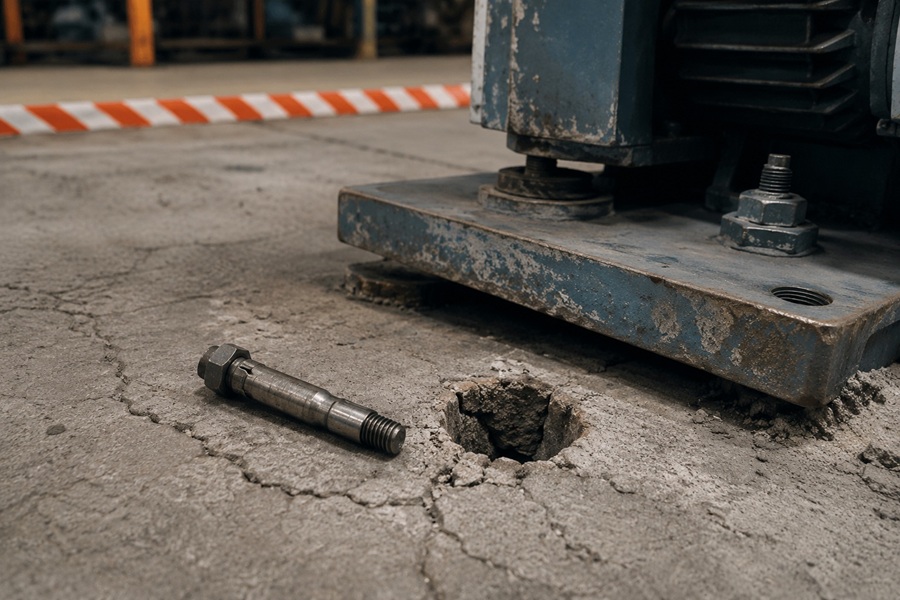
The compressor base is anchored. The machine is aligned. The team is ready to commission.
Then the anchor pulls out.
It happens more than most project reports admit. A fastener is selected based on availability, not application. The wrong anchor goes into the wrong concrete. Under load — or under vibration — it fails. The result is downtime, rework, and in structural applications, a safety issue that no project manager wants to explain.
The root cause is almost always the same: the anchor was never properly matched to the application.
Pin type anchor fasteners are one of the most widely used mechanical anchoring solutions in Indian construction and industry. They are fast to install, code-compliant, and capable of holding significant tensile and shear loads. But like any engineering component, they work best when the right size and material are selected for the specific job.
This guide covers exactly where pin type expansion anchors are used, what load capacities to expect, which material grades suit which environments, and how to avoid the mistakes that cause anchors to underperform. Whether you are a structural engineer, procurement manager, or site contractor, this is the information you need before you specify or source.
A pin type anchor bolt is a mechanical fastening device. It secures structural elements, machinery bases, and equipment to concrete, masonry, or stone surfaces.
Here is how it works.
A pre-drilled hole is made in the concrete. The anchor sleeve is inserted into the hole. When a hardened steel pin is driven into the sleeve, the sleeve expands outward against the walls of the drilled hole. This creates a strong friction-based grip. The result is high pull-out resistance — without any epoxy, chemical resin, or bonding agent.
That is the key advantage. No mixing, no curing time, no waiting. Once the pin is driven, the anchor is loaded and ready.
This anchoring method is also called a sleeve-type expansion anchor or mechanical concrete anchor. The terms refer to the same product family. All of them rely on the expansion principle rather than chemical adhesion.
At Aim Tech Engineering, we manufacture pin type anchor bolts from M6 to M19 diameter in mild steel and stainless steel. Each bolt meets IS, DIN, and ASTM standards — so the load ratings are not estimates. They are verified values based on standardised testing.
Before covering applications, it helps to understand two terms you will see repeatedly.
Tensile load (pull-out load): This is the force required to pull the anchor straight out of the concrete, perpendicular to the surface. It matters most when the anchor holds something that tends to lift or separate from the base — like a machine subject to vibration, or a base plate under uplift wind load.
Shear load: This is the force acting parallel to the concrete surface — sideways across the bolt. It matters most in structural connections where lateral forces (wind, seismic movement, machinery torque) act on the bolt.
Most real-world applications involve a combination of both. The table below gives the rated values for our standard range.
| Code | Size | Tensile Load | Shear Load |
| AM-F-M6 × 35 | M6 | 350 Kgs | 700 Kgs |
| AM-F-M8 × 40/50 | M8 | 750 Kgs | 1200 Kgs |
| AM-F-M10 × 50 | M10 | 1250 Kgs | 2000 Kgs |
| AM-F-M12 × 60 | M12 | 1750 Kgs | 3000 Kgs |
| AM-F-M14 × 125 | M14 | 2100 Kgs | 4000 Kgs |
| AM-F-M16 × 100 | M16 | 2750 Kgs | 5000 Kgs |
| AM-F-M16 × 200 | M16 | 3870 Kgs | 7000 Kgs |
| AM-F-M19 × 200 | M19 | 3870 Kgs | 7000 Kgs |
All values are based on M20 or higher grade concrete. In lower-grade concrete, capacity reduces. Always confirm your concrete grade before selecting anchor size.
This is the most common industrial application of pin type anchor bolts in India.
When a compressor, pump, CNC machine, generator set, or motor frame needs to be secured to an RCC slab, the anchor must do two things well: resist pull-out under static load, and hold firm under continuous vibration.
Pin type expansion anchors handle both when correctly specified.
For a mid-weight industrial compressor, an M16 × 200 anchor rated at 3870 Kgs tensile and 7000 Kgs shear is a strong match. For lighter equipment like small motors or HVAC units, an M10 or M12 anchor is typically adequate.
What engineers and contractors often miss:
Where dynamic loads are unusually high — like crushers, shredders, or large reciprocating compressors — consider upgrading to heavy-duty foundation bolts that are cast into the foundation during pour.
In steel frame construction, columns and beams connect to RCC foundations through base plates. Those base plates are anchored with bolts. That is where pin type anchor fasteners prove their value in civil and structural work.
The shear load capacity of M16 and M19 pin type anchors — up to 7000 Kgs — makes them suitable for anchoring structural base plates that carry lateral forces from wind or frame action. For a standard single-storey industrial shed or PEB structure, an M16 anchor bolt at each column base handles the load comfortably when the 4-bolt or 6-bolt pattern is designed correctly.
Key design consideration: Edge distance matters. The anchor must sit far enough from the concrete edge to prevent spalling. Per IS 5624, maintain a minimum edge distance of at least 6× the bolt diameter. If the footing is narrow, this may limit your anchor choice — or require upgrading to a larger footing rather than a smaller bolt.
For multi-storey buildings or structures with higher base shear demands, cast-in-place medium or heavy-duty foundation bolts designed per IS 5624 provide greater reliability.
On infrastructure sites, speed matters as much as strength. Pin type anchor fasteners are a preferred choice because they can be installed in drilled holes on live structures — no formwork, no embedment scheduling, no cure time.
Common uses include:
The friction-based grip of the pin expansion mechanism is well suited to concrete deck surfaces. If an anchor needs to be removed or replaced later — due to damage or relocation of a sign — the hole can be re-drilled and a new anchor installed. That is not always possible with cast-in or chemical anchor systems.
Corrosion consideration for outdoor infrastructure:
Plain mild steel anchors are not suitable for outdoor exposure over long project lifespans. Specify hot-dip galvanised mild steel for inland highway or bridge applications. For coastal locations or marine environments, use stainless steel — either SS 304 or SS 316 depending on chloride exposure level.
MEP contractors use pin type anchor fasteners daily — often without realising that the product family has a formal name. If you have ever drilled a hole in a concrete column, tapped in a sleeve, and driven a pin to fix a cable tray bracket, you have used this system.
For cable tray supports and conduit clamps, the load requirements are light. An M6 × 35 anchor rated at 350 Kgs tensile handles a fully loaded cable tray comfortably. An M8 × 50 anchor at 750 Kgs covers heavier tray systems.
For switchgear panels, MCC panels, and distribution boards mounted to concrete walls, M10 or M12 anchors are the standard choice.
Practical check before installation:
Always confirm that the slab or wall thickness is enough for the required embedment depth. An M10 anchor needs roughly 50–60mm of embedment for full rated capacity. If you are drilling into a 75mm slab, a shorter bolt or a different anchor system may be needed.
Also check for rebar before drilling. On reinforced slabs, hitting rebar during drilling is a common site problem. Use a rebar scanner if anchor positions are fixed.
Pre-engineered buildings (PEB), mezzanine floors, industrial shelving, and pallet racking all share one requirement: the column or upright base must be anchored securely to a concrete floor slab.
Pin type anchor bolts are the standard fastener for these applications across India. For warehouse racking systems, the typical specification is M12 or M14 anchors at each upright foot — selected based on the racking supplier’s anchor schedule and the applied loads.
One critical point that installation teams often overlook:
Racking systems are subject to forklift impact. A pallet racking upright hit by a forklift sees a sudden shock load. The anchor must handle that, not just the static load of the rack and its inventory. Always verify shear capacity in the anchor selection, not just tensile. An M12 anchor rated at 3000 Kgs shear handles most standard racking applications. For heavy-duty racking in high-traffic warehouses, move up to M14 or M16.
Do not substitute anchor specifications from a racking supplier’s design without checking load compatibility. That substitution is a frequent source of racking failures during forklift incidents.
Power generation and transmission sites have specific demands that most fastener suppliers do not fully address. At Aim Tech Engineering, we supply to this sector regularly — so we understand the requirements.
Common applications in this sector:
The key specification requirements for this sector:
Material traceability: IS 1367 Part 3 compliance ensures that every batch of bolts has documented metallurgical properties. For government or PSU projects, this is often a mandatory procurement requirement. We provide full material test certificates (MTCs) with every order.
Stainless steel for electrical environments: In substations, stray currents are a concern. Stainless steel anchors with isolating washers are recommended wherever there is a risk of galvanic corrosion from contact between the anchor and dissimilar metals in the mounting structure.
Dimensional compliance to IS/DIN/ASTM: Government infrastructure projects often audit fastener specifications. Using bolts that are manufactured and dimensioned to IS 5624 and DIN 529 ensures your supply chain passes that audit.
Choosing the right material is as important as choosing the right size. Here is a straightforward guide.
| Site Condition | Recommended Material | Reason |
| Indoor factory / dry industrial | Mild steel (MS) | Cost-effective, meets IS ratings |
| Outdoor / general weather exposure | Hot-dip galvanised MS | Zinc coating prevents atmospheric rust |
| Coastal / high humidity | Stainless steel SS 304 | Resists salt and chloride corrosion |
| Marine or chemical plant | Stainless steel SS 316 | Superior resistance to chlorides and acids |
| High-temperature zones (above 150°C) | Alloy steel — consult specification | Standard MS loses strength at elevated temperatures |
A common mistake is specifying mild steel anchors for outdoor infrastructure projects in coastal Maharashtra. Within a few monsoon cycles, corrosion compromises the anchor’s grip. The right material upfront is far less expensive than replacement after installation.
This is a section most product guides skip. We include it because honest guidance builds the trust that good engineering decisions require.
Do not use pin type expansion anchors in these situations:
Cracked concrete: Expansion anchors rely on tight friction contact with the hole wall. In cracked concrete, the crack can propagate and reduce that contact. For cracked concrete, use post-installed chemical anchors that are tested and certified to ETAG 001 Annex C for Condition B.
Very thin concrete sections (less than 75mm): The embedment depth required for full load capacity cannot be achieved in thin slabs. Either upgrade the section or use a different anchor type suited to shallow embedment.
High seismic or dynamic load applications: Cast-in J-bolt or L-bolt foundation anchors embedded during the concrete pour provide superior performance in structures designed for seismic loads. If your project has a seismic zone III, IV, or V classification per IS 1893, consult your structural engineer before specifying expansion anchors for primary structural connections.
Hollow block or AAC masonry walls: Standard expansion anchors require solid concrete to develop their load ratings. In hollow blocks, the expansion mechanism can crack the web. Use anchors specifically designed for hollow cavity walls.
Frequent equipment relocation: If machinery needs to be moved and repositioned regularly, a system that requires re-drilling each time may not be practical. Consider cast-in inserts or other reusable anchoring systems for mobile equipment layouts.
Even the right anchor will underperform if installation is done incorrectly. These are the practices that matter most.
On structural connections or machinery foundations where failure would be costly, carry out proof-load testing on a sample of installed anchors before full commissioning. Document torque values and inspection records per your project quality plan.
When requesting a quotation or raising a purchase order, include the following information:
If you are unsure of the size or material for your application, share the load requirements and site conditions with our team. We will help you select the right specification.
Aim Tech Engineering Solutions Pvt. Ltd. is an ISO 9001:2015 certified manufacturer based in Pune with 25 years of experience in specialised fasteners and foundation bolts. We supply to civil construction, infrastructure, and industrial sectors across India.
What makes us a reliable supplier for your project:
We serve the pre-engineered building industry, dairy processing plants, cement and steel mills, power infrastructure, and telecom tower projects — among many others.
Pin type anchor fasteners are not a commodity item to be picked off a shelf by size alone. The right anchor is a function of the load, the concrete grade, the environment, and the application type.
When these factors are matched correctly, a pin type expansion anchor delivers reliable, high-strength concrete anchoring that holds through vibration, weather, and decades of service. When they are mismatched, even a correctly sized anchor will underperform.
The guidance in this article gives you the foundation to specify correctly — from machine bases and structural columns to cable trays, racking systems, and power plant equipment. Use the load tables, material guide, and application notes as your reference.
When you are ready to source, speak to a manufacturer who can support the full specification — not just supply the bolt.
Aim Tech Engineering manufactures IS, DIN, and ASTM-compliant pin type anchor fasteners from M6 to M19 — available in mild steel and stainless steel, with custom sizing and bulk supply from our Pune facility.
Whether you are anchoring a compressor base in a manufacturing plant, securing structural steel on an infrastructure project, or fitting out a substation — we can help you select the correct size, material, and grade for your specification.
View Full Product Specifications and Get a Quote → foundationbolts.net/pin-type-anchor-bolt