- Nandoshi - Pune - 411024
- +91 - 97641 13247
- AESPL4@GMAIL.COM

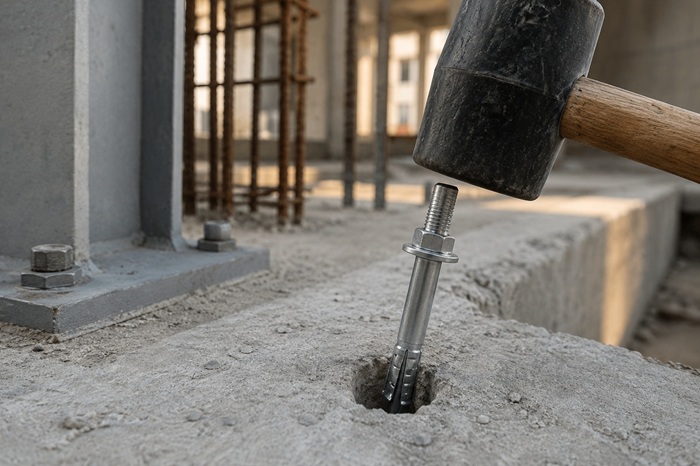
If you’ve ever watched a structural steel column being bolted down to a concrete plinth, or seen a compressor unit being fixed to a factory floor – those fasteners going into the concrete are doing a very specific job. They’re not just bolts. They’re expansion anchors, and the pin type variant is one of the most widely used mechanical fasteners across Indian construction sites and industrial plants.
This guide explains what anchor pins actually do, where they’re used, what loads they’re expected to carry, and how to choose the right one – written for engineers, site supervisors, and procurement teams who need clear, practical answers before specifying or purchasing.
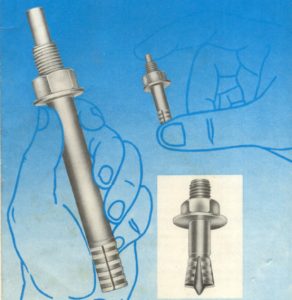
A pin type anchor bolt is a mechanical concrete fastener made of two parts: a slotted steel sleeve and a hardened steel pin. You drill a hole into the concrete or masonry, insert the sleeve, then drive the pin into the sleeve using a hammer. As the pin is driven in, it forces the sleeve to expand radially outward against the walls of the drilled hole. The result is a tight, friction-based mechanical grip that resists both being pulled out (tensile load) and being pushed sideways (shear load).
The key distinction from chemical anchors is that there’s no adhesive, no mixing, no curing time, and no temperature-sensitive installation process. The anchor is mechanically active the moment the pin is driven home. For sites with multiple anchor points, time-sensitive shutdowns, or simply contractors who want a reliable, repeatable process – that matters.
These fasteners go by several names depending on who’s specifying them: expansion anchor bolts, sleeve-type anchor fasteners, concrete pin anchors, mechanical wedge anchors. They’re all describing the same working principle.
The short answer: anywhere you need to fix something solid to concrete, masonry, or stone – from a lightweight cable tray bracket on a wall to a 10-tonne compressor base on an RCC slab. Here’s how that plays out across real applications.
This is one of the most demanding applications for expansion anchor bolts. When you’re fixing the base of a compressor, a pump, a diesel generator, or a CNC machining centre to a concrete slab, you’re dealing with two simultaneous force types: the static weight of the machine pressing down, and the dynamic shear forces generated by vibration, torque, and start-stop cycles.
Most failures in machinery anchoring don’t come from tensile overload – they come from underestimating shear. A 16mm pin type anchor bolt with a 200mm embedment depth, for example, carries up to 7,000 kg in shear. That’s a meaningful number when you’re calculating the anchor pattern for a rotating assembly.
Practical point for site engineers: Always check both the pull-out (tensile) and shear load ratings when specifying for machinery. Don’t size the bolt only on machine weight.
Common machinery applications:
In civil and structural construction, pin type anchor bolts are used to connect steel structural members to concrete foundations. A steel column doesn’t weld directly to concrete – it sits on a base plate, and that base plate is bolted down to the plinth using anchor fasteners.
For structural applications, the engineer of record will typically specify minimum embedment depth, bolt grade, and edge distance from the concrete face. IS 5624 and DIN 529 both provide dimensional standards for this. When the anchor bolt supplier is manufacturing to these standards, site teams can be confident the tolerances and load capacity match what’s on the drawing.
Where this matters most:
Large-scale infrastructure projects use mechanical anchor fasteners in significant volumes – often specified in project tenders with IS or ASTM material compliance as a mandatory requirement.
Applications in this sector include:
For government and NHAI procurement, IS 1367 / ASTM A193 compliance documentation is usually required at the time of supply. This is not a formality – it guarantees minimum tensile strength, hardness, and dimensional accuracy that are independently verifiable.
MEP contractors are among the heaviest volume users of lighter anchor fasteners – M6, M8, and M10 sizes in particular. The applications are less dramatic than structural anchoring, but the cumulative quantity across a large commercial or industrial project is significant.
Where anchor pins appear in MEP work:
For most of these, M8 x 50 or M10 x 60 expansion anchors cover the load requirements. The main consideration here is whether the concrete substrate is of adequate strength – hollow blocks and AAC panels are not suitable for expansion-type mechanical anchors.
In power generation and electrical infrastructure, anchor fasteners need to perform reliably over long service lives in environments that may be humid, corrosive, or subject to electrical hazards.
Typical applications:
In outdoor substations or coastal locations, hot-dip galvanised or stainless steel SS304 anchor bolts are specified to resist corrosion over a 20-30 year service life. Mild steel anchors with standard zinc plating are fine for interior or dry environments, but they’re not the right choice for exposed outdoor use or areas with chemical exposure.
One often-overlooked application is the anchoring of industrial storage systems and fabricated steel structures. Pallet racking in warehouses, industrial mezzanine floors, overhead crane rail foundations, and equipment platforms all use expansion anchor bolts at their column bases.
The design loads here are often set by the racking or structure manufacturer, and the anchor specification should match – both in embedment depth and in the concrete strength assumed. Racking installers in India frequently use M12 or M16 pin type anchors for upright bases, with M10 anchors for accessory brackets.
Getting the anchor selection right isn’t complicated, but it does require working through a few basic parameters before specifying.
Step 1 – Know your load type. Is the primary force pulling the anchor out (tensile), pushing it sideways (shear), or both? Machinery and structural columns usually need both checked. Cable trays are primarily shear-loaded.
Step 2 – Know your concrete. Higher-grade concrete (M25, M30) gives better pull-out performance than M15 or M20. If the concrete is old, damaged, or of unknown grade, use a larger bolt with more embedment depth.
Step 3 – Choose the right size.
| Application Type | Recommended Size Range |
| Light MEP (cable trays, conduit, panels) | M6 to M10 |
| Medium MEP and light structural | M10 to M12 |
| Structural base plates, beams | M12 to M16 |
| Heavy machinery bases | M14 to M19 |
| Infrastructure (crash barriers, gantries) | M16 to M19 |
Step 4 – Choose the right material.
| Environment | Recommended Material |
| Interior, dry | Mild steel, zinc plated |
| Outdoor, general | Hot-dip galvanised |
| Coastal, humid, or mildly corrosive | Stainless steel SS304 |
| Chemical plants, washdown areas, pharma | Stainless steel SS316 |
Step 5 – Check embedment depth. Longer bolts mean deeper embedment and higher load capacity. Never assume that a shorter bolt will be “good enough” – published load tables assume minimum embedment as per IS or DIN standards.
There’s a practical reason IS 1367, DIN 529, and ASTM A193 are called out in project specifications – not just for government tenders, but across commercial and industrial projects. These standards define:
A bolt that looks identical but doesn’t meet these material or dimensional requirements will have an unpredictable load capacity. In the best case, this causes equipment misalignment. In the worst case, it causes structural failure or a safety incident.
ISO 9001:2015 certification at the manufacturing level means there’s a documented quality management system ensuring consistent production – not just on the batch that was tested, but on every batch. This matters when you’re placing a bulk order for a large project and can’t test every individual fastener.
The difference between sourcing anchor fasteners from a trader and sourcing directly from a manufacturer is more than price. A manufacturer can provide material test certificates, dimensional compliance reports, and documentation to IS/DIN/ASTM standards – which traders sourcing from multiple origins often cannot. For government projects, infrastructure tenders, and quality-audited industrial facilities, this documentation is not optional.
It’s also worth noting that custom sizes – non-standard lengths, special materials, or large volume orders with specific embedment requirements – are only practical through direct manufacturer engagement. A trader won’t be able to accommodate a project-specific variation at short notice.
Pin type anchor bolts are used wherever a reliable, fast, tool-minimal connection is needed between a structural or mechanical element and a concrete or masonry base. They appear in:
The right choice of size, material, and embedment depth depends on your specific load conditions and environment. Getting that selection right – and sourcing from a manufacturer who can back it with standard compliance documentation – is what separates a reliable installation from one that causes problems later.
Aim Tech Engineering has been manufacturing IS/DIN/ASTM-compliant pin type anchor bolts from Pune since 2000. We supply to EPC contractors, infrastructure developers, industrial plants, and MEP contractors across Maharashtra and India.
Tell us your application, load requirement, and environment – we’ll recommend the right size and material, or manufacture a custom specification if needed. We supply from M6 to M19, in mild steel, stainless steel, zinc plated, and hot-dip galvanised – with full documentation for compliance-sensitive projects.
Both are mechanical expansion anchors designed for use in concrete. A pin type anchor bolt uses a driven pin that expands the sleeve inside the drilled hole using only a hammer. A wedge type anchor bolt expands when the nut is tightened, pulling an internal wedge upward. Wedge anchors are commonly used where a threaded connection is required above the surface, while pin type anchors are preferred for flush or low-profile installations.
Pin type anchor bolts should only be used in solid and dense masonry materials. They are not recommended for hollow concrete blocks, AAC blocks, or weak and deteriorated brickwork. Since the expansion mechanism requires solid surrounding material to create holding strength, hollow or soft substrates may lead to failure.
The correct anchor size depends on the machine weight, vibration levels, number of fixing points, and base plate dimensions. In most industrial applications, M12 to M16 anchor bolts are suitable for pumps, compressors, and medium-duty machinery. Larger equipment such as presses or rotating assemblies may require M19 anchors. For critical installations, load calculations should always be verified by the equipment manufacturer or a structural engineer.
For coastal regions such as Mumbai, Ratnagiri, and Sindhudurg, stainless steel SS304 anchor bolts are strongly recommended because of high humidity and salt exposure. In inland cities like Pune, Nashik, and Aurangabad, hot-dip galvanised anchor bolts are generally sufficient for outdoor applications. SS316 anchor bolts are typically used only in highly corrosive or chemical environments.
Yes. Many manufacturers offer custom-made anchor bolts based on project requirements or client drawings. While standard sizes are suitable for most applications, custom lengths, embedment depths, and threaded projections can be manufactured when specified during the enquiry stage.
The number of anchor bolts required depends on factors such as load conditions, concrete strength, base plate dimensions, and safety requirements. This should be determined by a qualified structural engineer. Anchor bolt manufacturers can assist by providing load capacity data for specific bolt sizes and configurations.