- Nandoshi - Pune - 411024
- +91 - 97641 13247
- AESPL4@GMAIL.COM


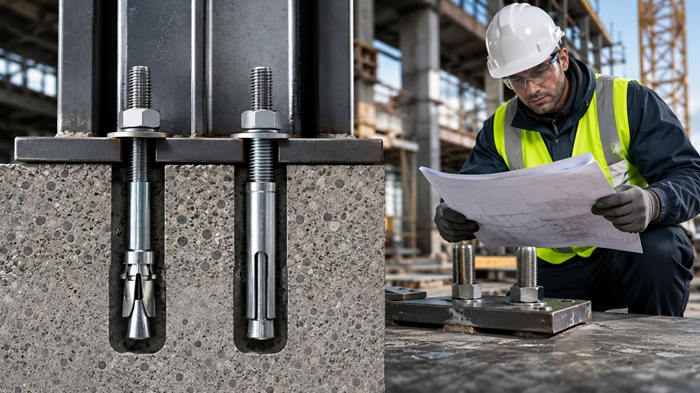
Wedge anchors and sleeve anchors are both post-installed mechanical expansion fasteners for concrete, but they’re not interchangeable. Wedge anchors deliver higher load capacity and suit structural, heavy-duty applications in solid concrete. Sleeve anchors are easier to set and work in masonry, hollow block, and lighter-load situations. Use this guide to choose confidently before you order or specify.
Imagine you’re on-site, two expansion bolts in hand, and no one can tell you which one goes into the drawing. You pick the easier one to install. The fixture goes up, the project moves forward. Then, six months later, an anchor pulls out under load.
That scenario plays out more often than it should. The choice between a wedge anchor and a sleeve anchor looks minor at the specification stage. On site, under load, it isn’t.
At Aim Tech Engineering, we’ve been manufacturing specialised fasteners and foundation anchor bolts for over 25 years. We supply EPC contractors, structural engineers, and procurement teams across India. And the question we get most often isn’t about size or grade. It’s this: “Which anchor type do I actually need?”
This guide answers that question clearly, with real application examples, a side-by-side comparison, and a five-step specification checklist you can use on your next project.
A wedge anchor bolt is a post-installed mechanical expansion fastener that locks into hardened concrete through friction. You insert it into a pre-drilled hole, place your fixture and washer, thread the nut on, then tighten to a specified torque. As the nut tightens, the bolt shaft pulls upward and forces a wedge collar at the embedded end to expand outward against the hole wall. That outward pressure is what holds the anchor in place under both tension and shear loads.
The torque value isn’t a guideline. It’s the mechanism. If you under-tighten, the wedge doesn’t fully expand. If you over-tighten, you can crack the concrete around the hole or strip the thread. Both outcomes reduce the anchor’s rated load capacity.
For Aim Tech’s AM WA series, the correct installation torque by bolt size is:
Always use a calibrated torque wrench. A click-type wrench set to the correct value takes the guesswork out completely.
Our wedge type anchor bolt range covers M8 to M20, with anchor lengths from 75 mm to 250 mm depending on the thread diameter. Custom sizes are available on request.
A sleeve anchor uses a full-length expansion sleeve that wraps around the bolt body from the head down to the embedded tip. When you tighten the nut, the sleeve expands outward along its full length, distributing the clamping force over a larger surface area inside the hole. This is fundamentally different from a wedge anchor, where expansion happens only at the bottom of the embedded end.
That difference in mechanism has a practical consequence: sleeve anchors are more forgiving in soft or hollow substrates. The distributed expansion means they can grip in aerated concrete, hollow block, and light masonry where a wedge anchor would simply spin or fail to set.
The trade-off is load capacity. Because sleeve expansion is more diffuse, sleeve anchors don’t match the concentrated grip of a wedge collar in solid concrete. For equivalent bolt diameters, a wedge anchor will typically carry a meaningfully higher tension and shear load than a sleeve anchor in the same concrete grade.
Sleeve anchors also have one installation advantage: the bolt itself can be removed after setting, while the sleeve remains in the hole. This makes them partially reusable in non-structural applications where you might need to detach and reattach a fixture later.
Here’s a direct comparison across the criteria that matter most at the specification stage.
| Feature | Wedge Anchor | Sleeve Anchor |
| Expansion mechanism | Wedge collar at embedded end only | Full-length sleeve along bolt body |
| Load capacity | Higher tension and shear capacity | Lower to moderate |
| Best substrate | Solid, uncracked concrete | Concrete, hollow block, aerated concrete, masonry |
| Installation requirement | Calibrated torque wrench required | Torque wrench recommended; more forgiving |
| Removable after setting? | No — permanent installation | Bolt removable; sleeve stays in hole |
| Cracked concrete suitability | Standard grade: not recommended | Not recommended |
| Typical applications | Structural steel, machinery bases, PEB columns, barriers | Handrails, cable trays, panels, light fixtures |
| Available in IS / ASTM / DIN? | Yes (Aim Tech AM WA series) | Varies by manufacturer |
The most important column in that table is the substrate. If you’re in solid, uncracked concrete and the load is structural, the wedge anchor is the correct choice. If the substrate is hollow block or the load is light and non-structural, a sleeve anchor may be more practical.
For a complete overview of the anchor bolt types we manufacture, visit our anchor bolt product range.
Use a wedge anchor bolt any time your application involves a structural connection, significant load, or permanent installation in solid concrete. The friction-based wedge grip is specifically engineered for conditions where anchor failure would have safety or compliance consequences.
Here are the most common applications, and why each one calls for a wedge anchor specifically:
Pre-engineered building (PEB) column base plates PEB structures experience lateral shear from wind and seismic loads. The anchor bolts at column bases must resist both the vertical column load and the horizontal shear from the frame. A wedge anchor’s concentrated grip and high shear capacity make it the right choice here. A sleeve anchor in the same application would be under-specified.
Pump bases and compressor skids Rotating machinery creates continuous dynamic and vibration loads. These loads fatigue an anchor over time. Wedge anchors hold their grip under cyclic loading better than sleeve anchors, which is why they’re specified for motor mounts, pump skids, and compressor frames in industrial plants.
Highway crash barriers and safety structures Impact loads on crash barriers are sudden and high-magnitude. The anchor bolts must resist a shear force that arrives without warning. Structural-grade wedge anchors are the only appropriate fastener here.
Tower and mast structures Communication towers and overhead support structures experience overturning moments from wind. The tension load on the windward anchor bolts can be very high. Wedge anchors provide the embedment depth and expansion force needed to resist this.
One installation detail that matters in all these applications: minimum edge distance. Installing a wedge anchor too close to a concrete edge or to another anchor reduces its load capacity significantly. Always check the spacing requirements against your project drawing before drilling.
For lighter, non-structural applications, sleeve anchors are often the more practical choice. They’re easier to install in tight spaces, they tolerate slightly oversized holes better, and they work in substrates where wedge anchors can’t grip.
Here’s where sleeve anchors genuinely outperform:
Cable trays and conduit supports Electrical cable management systems carry distributed loads that are well within the capacity of a sleeve anchor. The ability to remove and reattach the bolt is useful during cable routing changes.
Electrical panel mounting and transformer bases These fixtures need a secure, vibration-resistant connection, but the loads are modest. Sleeve anchors in solid concrete handle this well. In hollow block walls, sleeve anchors are often the only post-installed option.
Light handrails and balustrades in masonry Masonry walls and hollow block partitions are common in commercial buildings. Sleeve anchors distribute their expansion across a larger contact area, which prevents the localised crushing that a wedge anchor can cause in softer substrates.
HVAC and suspended equipment Suspended ceiling systems and HVAC ductwork connections often go into hollow block or aerated concrete ceilings. Sleeve anchors are purpose-suited to this.
One important caution: do not substitute a sleeve anchor for a wedge anchor in any structural application just because it’s easier to source or install. If your drawing specifies an expansion anchor without naming the type, confirm with the project engineer before you order. The consequence of an under-specified anchor isn’t visible until it fails.
In over 25 years of manufacturing anchor bolts for PEB contractors, infrastructure companies, and industrial clients, the specification errors our engineering team sees most often fall into five categories.
To choose the correct expansion anchor, you need five pieces of information. With these five inputs, you can match the anchor to the correct load table and confirm the size, embedment depth, and torque value before you order.
Step 1: Confirm the substrate Is the base material solid, uncracked concrete? Hollow block? Aerated concrete? Masonry? Solid concrete opens both anchor types as options. Hollow or soft substrates narrow you to a sleeve anchor or a specialist anchor type.
Step 2: Read the design loads from the structural drawing Look for the tension load (axial pull-out force) and the shear load (horizontal force at the anchor). Both values are needed. If the drawing doesn’t specify, ask the structural engineer. Never guess at design loads.
Step 3: Calculate the required embedment depth Your anchor’s load table shows allowable loads at various embedment depths. Match the required load to the corresponding embedment. If the required embedment is deeper than a standard anchor length allows, you may need a longer anchor or a different anchor type.
Step 4: Check edge distance and anchor spacing Lay out your anchor positions on the drawing. Confirm that every anchor meets the minimum edge distance and that the centre-to-centre spacing between anchors doesn’t reduce the group capacity below what the design requires.
Step 5: Confirm the installation torque Note the correct torque value for your selected bolt size. Ensure the site team has a calibrated torque wrench before installation begins. Add the torque value to the installation instruction sheet for the contractor.
If any of these five inputs is unclear, Aim Tech’s engineering team can help you work through the selection before you commit to an order. It’s faster and cheaper to get the specification right now than to rework anchors on-site after the concrete is drilled.
Contact us via our technical inquiry and quote page for project-specific support.
The choice between a wedge anchor and a sleeve anchor comes down to three things: the substrate, the load, and the consequence of failure.
Wedge anchors belong in structural and heavy-duty industrial applications in solid, uncracked concrete. Column base plates, machinery foundations, crash barriers, and PEB structures all fall into this category. The AM WA series from Aim Tech Engineering covers M8 to M20 and is manufactured to IS, ASTM, and DIN standards with full material test reports on every order.
Sleeve anchors suit lighter, non-structural work and applications in hollow block or masonry. They’re more forgiving to install and partially removable, but they’re not a structural substitute.
If you’re not certain which anchor your project needs, that’s the right time to call. Our engineering team helps EPC contractors, structural consultants, and procurement teams specify the correct anchor type, size, grade, and finish for every application. With ISO 9001:2015 certification and 25 years of manufacturing experience, we supply across India with full compliance documentation.
Request a technical consultation or get a quote for your project before your next order. A five-minute conversation at the specification stage saves far more than that on-site.
Can I use a sleeve anchor instead of a wedge anchor? You can only substitute a sleeve anchor for a wedge anchor if the sleeve anchor’s rated load capacity meets or exceeds the design load on your drawing, and the substrate is suitable. In structural applications such as column base plates, machinery foundations, or safety barriers, wedge anchors are the correct specification. Substituting a sleeve anchor in these applications without an engineer’s confirmation introduces a genuine structural risk.
What is the load capacity difference between a wedge anchor and a sleeve anchor? Wedge anchors typically carry higher tension and shear loads than sleeve anchors of the same diameter. This is because the wedge collar creates a concentrated, high-friction grip at the embedded end of the hole. The exact load difference depends on the concrete grade, embedment depth, and edge distance for each specific bolt size. Always refer to the manufacturer’s published load table rather than assuming equivalence between anchor types.
Can a wedge anchor bolt be removed after installation? Wedge anchor bolts are permanent fasteners. Once the wedge collar expands against the concrete, the anchor cannot be removed without damaging the substrate. The bolt can sometimes be cut flush with the surface, but the sleeve and wedge assembly remains embedded in the concrete. If your application requires a removable fastener, specify a through-bolt type or consult Aim Tech’s engineering team about alternative anchor types.
What concrete grade is required for wedge anchor bolt installation? Most published load tables for wedge anchor bolts are calculated for concrete with a minimum compressive strength of C20/25 (M25 grade). Using the same anchor in lower-grade concrete, such as M15, can reduce the allowable load by 30% or more. Always verify the actual concrete grade from the project specification or site test results before finalising your anchor selection. If in doubt, contact the manufacturer’s engineering team with the concrete grade and design load.
What is the minimum edge distance for a wedge anchor bolt? Minimum edge distance depends on the anchor diameter. As a general starting point, standard installation requires an edge distance of at least 5 to 6 times the anchor diameter (5d to 6d). For an M12 wedge anchor, this means at least 60 to 72 mm from the nearest concrete edge. Installing closer to the edge than the specified minimum reduces load capacity and creates a risk of concrete edge breakout. Always confirm edge distances against the manufacturer’s specification table and your project drawing before drilling.